
 Sale
Tree of Life Intarsia Pattern
Original price was: $20.00.$9.99Current price is: $9.99.
Build beautiful wood art with the Tree of Life Intarsia Pattern. Includes a 17-page PDF guide, tracing grids, sizing, wood selection and assembly.
Digital ProductNo physical shipping
Secure CheckoutProcessed by WooCommerce
Workshop ReadyReview product details below
About this pattern
Pattern Description
Read the complete product information before purchasing.
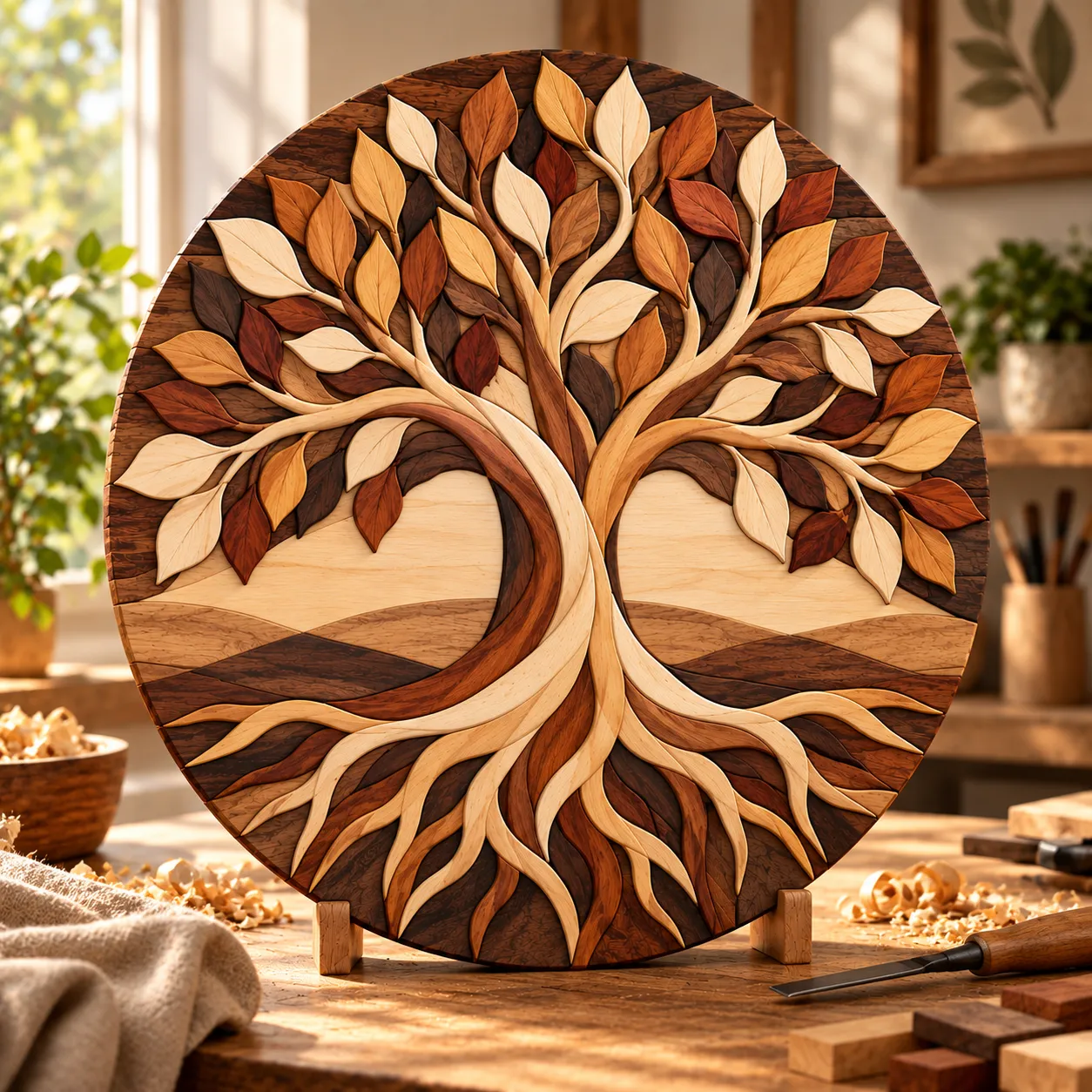
Create meaningful wooden artwork with this Tree of Life Intarsia Pattern, a detailed digital scroll saw woodworking project featuring a beautifully sculpted tree with flowing branches, colorful leaves, intertwined roots, and a circular natural wood background.
Inspired by the beauty of nature and the symbolism of growth, strength, and connection, this design combines warm cream, honey-gold, copper, reddish-brown, and dark walnut wood tones to create an elegant three-dimensional composition.
The artwork features a gracefully twisting tree trunk that rises into an expansive canopy of individually shaped leaves. Below the trunk, broad roots spread across a layered landscape, creating a balanced design.
Unlike ordinary flat wooden decorations, this intarsia pattern uses separately cut and sculpted wooden components to create depth, texture, and natural movement.
Whether you enjoy intarsia woodworking, scroll saw projects, or creating meaningful handmade gifts, this Tree of Life design offers an engaging project that combines craftsmanship with artistic expression.
The digital product includes a detailed 17-page beginner-oriented PDF guide covering wood selection, sizing, reference tracing, cutting, shaping, assembly, and finishing.
If you are new to this technique, explore our Intarsia for Beginners guide before beginning.
Tree of Life Intarsia Pattern for Beautiful Wooden Wall Art
The design features a large Tree of Life positioned inside a circular wooden background.
Its curved trunk is composed of contrasting pale and medium-brown wooden sections, giving the appearance of intertwined wood flowing naturally upward.
Numerous individually shaped leaves create a full canopy with beautiful color variation.
Cream, golden-yellow, copper, reddish-brown, and dark walnut tones work together to create warmth and visual contrast.
The lower section features layered rolling hills in natural wood colors, while the tree’s roots extend across the foreground.
The combination of detailed foliage, flowing branches, and spreading roots creates a balanced botanical composition.
The Tree of Life is often associated with family, personal growth, connection, and resilience, making this design especially meaningful for nature-inspired woodworking projects.
What Makes This Tree of Life Intarsia Pattern Special?
One of the most distinctive features of this project is its detailed dimensional construction.
Instead of using one flat wooden silhouette, the design incorporates separately shaped sections for the trunk, branches, leaves, roots, and surrounding landscape.
The pale trunk sections contrast with darker interior curves, creating an attractive flowing effect.
Individual leaves feature carefully rounded surfaces that catch the light and emphasize their natural shapes.
The roots spread outward in graceful curves, adding visual balance and making the tree appear firmly connected to the surrounding landscape.
Natural wood grain provides texture that cannot be reproduced in exactly the same way on every project.
By selecting different wood species, woodworkers can create their own unique interpretation while preserving the original design’s overall appearance.
Learn more about dimensional woodworking in our What Is Intarsia? guide.
Tree of Life Intarsia Pattern Sizes and Resizing
The recommended starting diameter for this project is approximately 400 mm (15.75 inches).
This size provides practical working space for cutting the individual leaves, shaping the flowing trunk, and preparing the detailed root network.
The included guide explains proportional resizing so the entire composition can be adapted to different display requirements.
A smaller 250 mm (9.84-inch) version creates a compact decorative project but requires greater precision when cutting narrow branches and leaves.
A larger 600 mm (23.62-inch) version provides additional working space and can create a prominent wooden wall-art display.
For experienced woodworkers planning a statement piece, an 800 mm (31.50-inch) version is another option, provided the backing and mounting structure are appropriately reinforced.
The PDF explains how to calculate proportions using the selected outside diameter.
It also includes 10 × 10 and 20 × 20 reference grids to help transfer the design onto a full-size tracing master.
These visual references support the preparation of individual paper templates and a numbered assembly map.
Choosing Wood for Your Tree of Life Intarsia Pattern
Wood selection plays an important role in achieving the design’s warm, layered appearance.
For the pale trunk, branches, and roots, maple, holly, or basswood can provide attractive cream-colored surfaces.
Cherry, honey-toned maple, and similar warm woods can help create the golden leaves.
For the copper and reddish-brown leaves, cherry and sapele are useful options.
Walnut creates darker leaf sections, root shadows, and beautiful contrast around the lighter tree components.
The landscape can incorporate maple, birch, oak, cherry, or ash, depending on the desired balance of light and medium-brown tones.
A walnut-veneered plywood panel or another stable dark-brown backing can help create the circular background.
Before cutting, arrange your selected boards together under natural light.
Compare their colors, grain patterns, and thicknesses to ensure the finished artwork will have a balanced appearance.
Tree of Life Intarsia Pattern: Grain Direction and Cutting Tips
Wood grain direction is particularly important when working with narrow branches and delicate leaves.
For the trunk, align the grain along the direction of the main flowing sections whenever practical.
Individual leaf templates should generally be positioned so the grain follows the central vein from the base toward the pointed tip.
For the roots, choose grain directions that support their curved shapes while reducing fragile cross-grain sections.
Begin cutting with the larger background and landscape components.
Then prepare the major trunk sections, branches, and roots before moving to the smaller leaves.
A scroll saw fitted with a suitable fine woodworking blade helps cut detailed curves and pointed shapes.
Keep each component labeled and organized according to the full-size master.
Avoid forcing the saw blade through tight corners, and use suitable holding methods for small parts.
After cutting, gradually round the visible surfaces while preserving accurate fitting edges.
Detailed 17-Page Beginner Woodworking Guide Included
The accompanying PDF provides an organized introduction to constructing the Tree of Life design.
It begins with a visual overview of the artwork and explains the different layers that make up the finished composition.
The guide covers project sizing, proportional enlargement, material selection, wood colors, grain direction, tool preparation, and workshop safety.
Additional sections explain how to transfer the reference design onto paper, create a numbered cutting master, and prepare the circular backing.
The cutting instructions discuss handling individual leaves, long flowing branches, narrow trunk sections, and delicate roots.
Shaping guidance explains how to create gently rounded leaf surfaces, raised trunk sections, and naturally tapered roots.
The PDF also includes diagrams illustrating the construction layers and assembly sequence.
A detailed tracing workflow helps woodworkers develop their own full-size paper templates from the supplied visual reference grids.
This makes the guide useful for understanding the complete construction process rather than focusing only on the finished appearance.
Although the instructions are written for beginners, the numerous curved pieces and small details require patience and basic scroll saw handling skills.
Assembling and Finishing Your Tree of Life Wood Art
A stable circular backing provides the foundation for the entire design.
Begin by preparing the background and layered landscape sections.
Next, position the main trunk pieces, followed by the larger branches and spreading roots.
After these components are aligned, arrange the smaller branches and individual leaves.
Dry-fit the complete project before applying permanent adhesive.
This allows you to check the position of each component, identify visible gaps, and confirm the overall shape.
Once you are satisfied with the layout, apply a suitable wood adhesive to the flat contact surfaces and assemble the design in manageable sections.
Allow the adhesive to cure according to the manufacturer’s instructions.
After final sanding and cleaning, apply a compatible protective wood finish.
A matte or satin finish can highlight the natural grain while maintaining the warm character of the artwork.
Test your chosen finish on sample wood first, as oils and clear coats can change the appearance of pale and reddish woods.
Use properly rated hanging hardware or a stable display stand suitable for the weight of the completed artwork.
A Meaningful Woodworking Project and Handmade Gift Idea
The Tree of Life design can complement rustic living rooms, farmhouse interiors, home offices, entryways, cabins, and nature-inspired spaces.
Its symbolic appearance also makes it a thoughtful woodworking project for anniversaries, housewarmings, weddings, birthdays, and family celebrations.
A completed wooden Tree of Life can represent growth, family connections, and the beauty of nature.
The circular composition works well with natural furniture, warm neutral colors, and botanical decorative accents.
Because each wooden piece is selected, cut, and shaped individually, the finished artwork becomes a reflection of the maker’s craftsmanship.
Create Your Own Tree of Life Intarsia Artwork
The Tree of Life Intarsia Pattern combines artistic detail, natural wood textures, and meaningful symbolism in one decorative woodworking project.
From selecting beautiful contrasting woods to shaping the delicate leaves and flowing roots, each stage offers an opportunity to develop your intarsia woodworking skills.
The completed design can become a distinctive piece of handmade wooden wall art or a thoughtful decorative gift.
This product is a digital woodworking PDF guide, not a finished physical wooden decoration.
Wood, tools, adhesives, finishes, display stands, and other physical materials are not included.
The guide contains reference images and proportional tracing grids. Woodworkers use these references to prepare their own full-size cutting master before cutting the individual components.
Explore additional woodworking projects in our Intarsia Patterns Shop.
Please review our Digital Product License for information about the applicable usage terms.
Start your next creative project with the Tree of Life Intarsia Pattern and bring the natural beauty of dimensional wooden artwork into your home.
Simple purchase flow
From Pattern to Workshop
01
Choose Your Pattern
Review the product details, images and specifications.
02
Checkout Securely
Use the Card or PayPal purchase button to open the secure checkout for this pattern.
03
Access Your Purchase
Follow the instructions shown after successful payment to access your digital purchase.
04
Start Creating
Prepare your wood and begin your intarsia project.