

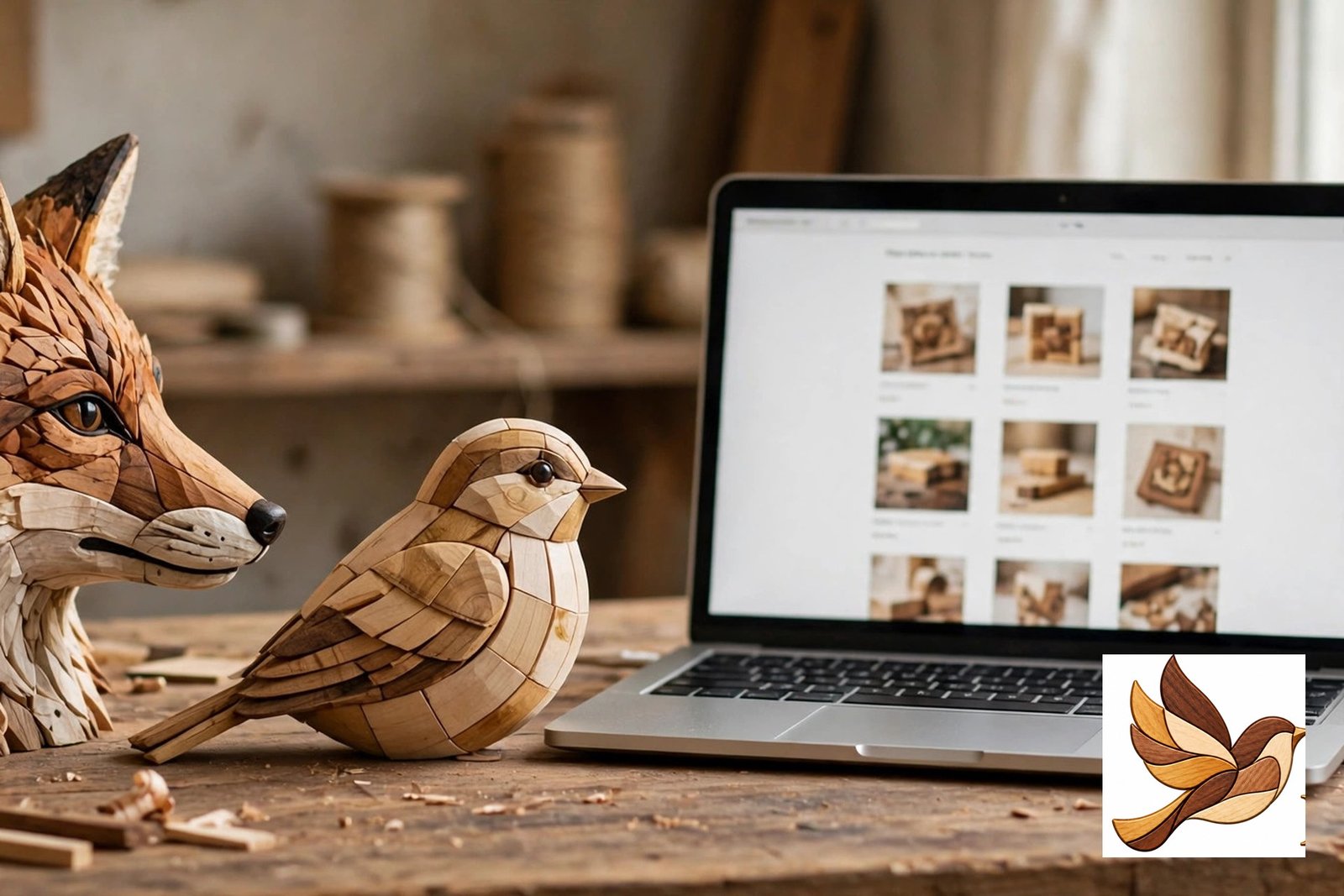
You have finished a piece you are proud of, and someone at the craft fair says, “You should sell these!” The next question is harder: where, and how? Learning how to sell intarsia online is not about finding one magic marketplace. It is about putting the right piece, with the right photos and the right price, in front of buyers who already want handmade wooden art — and then making it easy for them to trust you enough to buy.
This guide covers the whole path to how to sell intarsia online: choosing where to sell, photographing your work so it sells itself, writing a listing that answers a buyer’s questions before they ask them, and the mistakes that quietly cost makers sales. It builds on our guide to how to price intarsia, so if you have not set your prices yet, start there first.
How to Sell Intarsia Online: Where to Sell
Most makers start in one of three places, and each one suits a different kind of seller.
Your own shop. A shop on your own website gives you full control over prices, presentation and customer emails, and you keep the whole sale instead of paying marketplace fees. The trade-off is that you must bring your own visitors, through search, social media and word of mouth. If you already have an audience — a blog, a Pinterest following, a mailing list — your own shop is usually the most profitable home for your work.
A handmade marketplace. Marketplaces such as Etsy bring the buyers to you, which is why most beginners start there. You pay listing and transaction fees, and you compete side by side with other makers, but you do not have to build traffic from zero. Treat a marketplace shop as your storefront while your own site grows, not as your only home: fees and rules change, and a shop you do not own can close overnight.
Social media and commissions. Many makers sell their best work before it is ever listed, because a photo on Instagram or Pinterest brings a direct message asking, “Is this one for sale?” Pet portraits and personalised pieces work especially well this way, because the buyer is buying a likeness, not a stock item. Keep a simple commissions process — a short form, a deposit, a clear turnaround time — so a casual enquiry becomes a paid order instead of a long chat that goes nowhere.
The honest answer for most makers is to use two of the three: a marketplace for discovery and your own shop for repeat buyers. That combination is the simplest way to learn how to sell intarsia online without depending on one channel. Put the same pieces in both places, with the same prices, and let buyers choose where they feel comfortable.
Photograph Your Work Like It Is Already Sold
Online buyers cannot pick up your piece, feel its weight or run a finger over the shaped wood. Your photos have to do all of that work, and when you are learning how to sell intarsia online, they are the single biggest factor in whether a listing sells.
Photograph in soft daylight, near a window or outside in open shade, never under a yellow ceiling bulb. Use a plain, uncluttered background — a light wall, a wooden table, a linen cloth — so nothing competes with the piece. Take at least five photos: straight on, at a slight angle so the shaping and depth show, a close-up of the detail, the back with the hanger fitted, and the piece hanging on a wall so buyers can judge its size. A photo of the piece next to a familiar object, like a book or a mug, answers the size question better than any measurement.
Show the natural wood honestly. The colours in intarsia come from the wood species themselves, not from paint or stain, and buyers who understand that will pay for it. Do not over-edit: a photo that makes walnut look black will bring you a disappointed customer and a return. If you use a pattern from a shop, say so in the listing — buyers respect a maker who credits their pattern source.
Write a Listing That Answers Questions Before They Are Asked
A good listing is also central to how to sell intarsia online well: it reads like a helpful shop assistant. It should answer, in order: what is this, how big is it, what is it made from, how is it hung, and how long will it take to arrive.
Start with the subject and the story: “A woodland fox portrait, cut from walnut, cherry and maple — the colours are the natural wood, no paint or stain.” Then give the facts buyers actually check: overall size in centimetres and inches, number of pieces, wood species used, finish applied, whether a hanger is fitted, and whether the piece is ready to hang. Mention the pattern source and the care instructions in one short paragraph. Finish with shipping: how the piece is packed, how long dispatch takes, and whether tracking is included.
When you are working out how to sell intarsia online, use the words buyers search for. “Intarsia wood art”, “wooden animal portrait” and “handmade wooden wall art” are the phrases real buyers type; use them naturally in your title and first paragraph, not stuffed into a keyword list at the bottom. If you sell seasonal pieces, say so early — our guide to intarsia Christmas gifts shows how strongly occasion and recipient drive demand, and the same is true of birthdays, weddings and housewarmings all year round.
Price It Once, Price It Honestly
When you learn how to sell intarsia online, do not underprice to get your first sale, and do not change your prices every week. Buyers notice, and a maker who keeps discounting trains buyers to wait for the next sale. Use the formula from our pricing guide — materials, honest hours, overhead and margin — and then hold that price across every channel where you sell. The same piece at two different prices on two different sites is the fastest way to lose a buyer’s trust.
If a piece is not selling, the problem is almost never the price alone. Check the photos first, then the title, then whether the right buyers are seeing it at all. A beautiful piece with a dark, blurry photo will sit unsold at any price, while the same piece with five clear photos sells at full price. That is a lesson every maker learning how to sell intarsia online discovers sooner or later.
Packing, Shipping and the Unboxing Moment
Intarsia is fragile at the edges, and a piece that arrives chipped is a refund, a bad review and a lost customer. Wrap the piece in bubble wrap, then in a layer of cardboard on both faces, and pack it in a box with at least five centimetres of padding on every side. Mark the box “Fragile” and “This Way Up” — and pack as if the courier will ignore both labels, because sometimes they do.
A thoughtful unboxing is part of how to sell intarsia online: include a small card with the piece, with the wood species used, a line about the natural colours, and your shop name. It costs almost nothing, and it turns a delivery into an unboxing moment buyers photograph and share. That card is also the cheapest marketing you will ever buy — it is how a one-time buyer becomes a repeat customer who comes back for a gift.
Five Mistakes That Cost Makers Sales
Many of the mistakes below are easy to avoid once you know how to sell intarsia online — and fixing them costs nothing.
- One dark photo. A single photo taken under a yellow bulb tells buyers the work is amateur, whatever the cutting quality. Retake it in daylight.
- No size in the listing. “Medium” means nothing. Give centimetres and inches, and show the piece on a wall.
- Copying another maker’s listing. Buyers who shop handmade notice copied text, and so do search engines. Write your own words about your own piece.
- Ignoring messages. A buyer who asks a question and hears nothing for two days buys from someone else. Answer within a day, even if the answer is “let me check”.
- No hanger fitted. A piece that cannot go straight on the wall feels unfinished. Fit the hanger, show it in a photo, and say so in the listing.
How to Get Your First Sales
Your first sales, as you learn how to sell intarsia online, will almost always come from people who already know your work: friends, family, a woodworking group, followers who have watched you build pieces for months. Tell them you are selling before you list anything. Post the finished piece, say the price plainly, and say how to buy it. Most makers are shy about this step, and it is the step that matters most.
After that, consistency beats cleverness. List one new piece a week, share one honest workshop photo a week, and answer every comment. Search engines and marketplaces both reward shops that are active and complete, and buyers reward makers who are still there six months later. Learning how to sell intarsia online is a slow build, not a launch day — but every piece you sell teaches you something about what buyers want, and the next listing is always easier than the last.
Frequently Asked Questions
Do I need a business licence to sell intarsia online? Rules vary by country and by how much you sell, so check your local requirements before your first sale. Many makers start as a hobby seller and register once sales become regular income.
Should I sell on a marketplace or my own website? Start where the buyers already are — usually a marketplace — and build your own shop alongside it. Your own shop keeps more of each sale, but it only works once you can bring your own visitors.
How many pieces should I list to start? Five to ten finished pieces, each with five good photos, is enough to look like a real shop. One lonely listing rarely sells, however good the piece is.
What if a buyer wants a custom piece? Take a deposit of at least 50% before you cut anything, agree the subject, size and price in writing, and give a realistic turnaround time. Custom work is the most profitable part of how to sell intarsia online — and the part where a clear agreement matters most.

zaiduuu
Articles from IntarsiaPattern focus on intarsia woodworking, scroll saw techniques, digital patterns and practical project guidance.


Comments 0
Have a question or something useful to add? Share it below.