

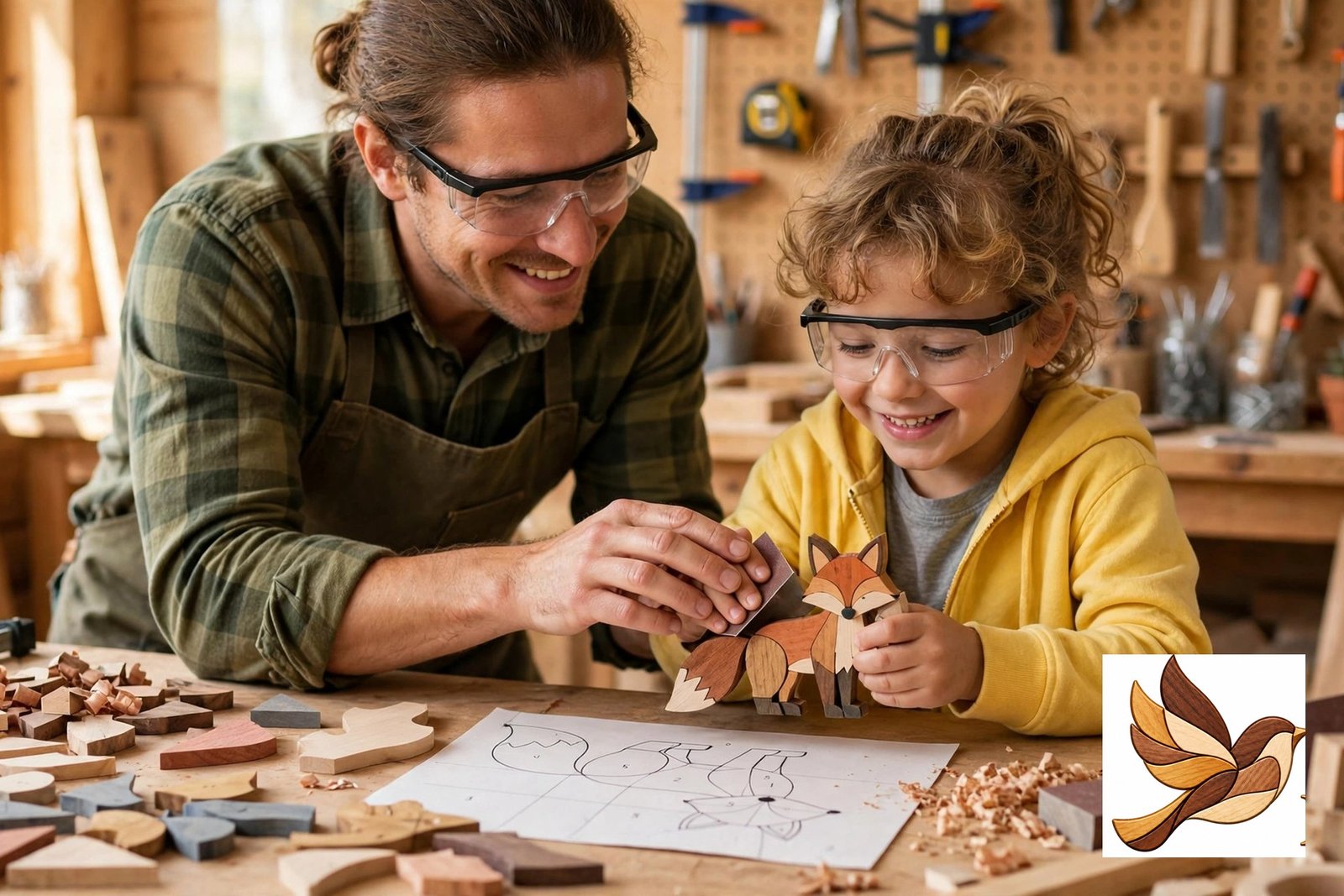
Intarsia looks like a grown-up craft: a scroll saw, dozens of small pieces, a pattern full of numbers. But intarsia with kids works beautifully — if you choose the right project, the right tools and the right job for each pair of hands. Children do not need to cut every piece to love intarsia. They need a piece they helped make, hanging on their own bedroom wall.
This guide to intarsia with kids is for parents, grandparents and teachers who want to share the craft safely: which ages can do what, which tools children should never touch, simple first projects that actually finish, and how to keep the whole thing fun instead of frustrating. If you are new to the craft yourself, read our guide to how to read an intarsia pattern first — everything here assumes an adult is running the saw.
Intarsia with Kids: What Age Can Do What?
There is no single right age for intarsia, because the craft splits neatly into safe jobs and saw jobs. A five-year-old can sand a piece, choose wood colours and glue a finished section. An eight-year-old can trace a pattern onto wood and sort pieces by number. A twelve-year-old, with close supervision and a proper safety talk, can make their first cuts on a scroll saw. The rule is simple: the child does the jobs that match their age, and the adult does the rest.
When you try intarsia with kids, keep sessions short for children under eight — twenty to thirty minutes is plenty — and finish with something visible: a sanded piece, a glued section, a finished animal. Young children judge a project by what changed while they were working, not by how many pieces are left. For older children, a full small project over two or three sessions is realistic, and the pride of finishing it is the whole point.
Safety First: The Jobs Children Never Do
The scroll saw is an adult-only tool in a family workshop, full stop. No child should switch it on, change a blade, or cut a piece unsupervised, whatever their age. The same goes for any power sander, for sharp chisels, and for finishes and glues that carry safety warnings — read the label together and let the adult handle them.
What children can safely do is more than you might think. Intarsia with kids works when children do the safe jobs: sanding with a sanding block is safe and genuinely useful, and a child who sands a piece smooth has improved the finished work. Sorting cut pieces by their pattern numbers is a quiet, absorbing job that teaches the pattern. Choosing which wood goes where — “should the fox be cherry or walnut?” — is a real design decision, and children take it seriously. Gluing, with a small brush and an adult watching the amounts, is safe for most children over seven. And the best job of all is the final one: rubbing on the finish and watching the colours come alive.
Set three house rules before you start, and say them out loud every time: hands away from the saw table when it is running, safety glasses on whenever anyone is cutting or sanding, and no reaching across the saw, ever. Children copy what they see, so wear your own glasses and follow your own rules without exception.
Choosing a First Project That Actually Finishes
The most common mistake with children is choosing a project that is too big. A 70-piece portrait is a wonderful gift and a terrible first project for a child — it takes too long, the pieces are too small, and enthusiasm runs out on day two. For intarsia with kids, pick a first project with 10 to 20 pieces, chunky shapes, and a subject the child already loves: a fish, a simple bird, a star, a heart, a dinosaur, their favourite animal.
Look for these signs in a pattern: pieces larger than a coin, no pieces thinner than a pencil, gentle curves instead of sharp points, and a clear colour map so the child can see which wood is which. A simple Christmas ornament is an ideal first project — it is small, it finishes in one or two sessions, and it hangs on the tree where the child can show it off. Our guide to intarsia Christmas gifts has ideas that work well as family projects, and a small ornament makes a gift the child is proud to give.
Cut the pieces yourself before the session, or cut them together with the child watching from a safe distance and sorting each piece as it comes off the saw. Either way, the child should arrive at a table full of pieces, not a table full of waiting.
A Simple Session Plan That Works
One session, three jobs, one visible result. That is the whole plan for intarsia with kids.
Session one: choose and sort. Lay out the pattern and the wood. Let the child match each piece to its number on the pattern and choose the wood for each part. This is the design session, and it is where the child takes ownership of the piece.
Session two: sand and fit. The child sands each piece smooth and tries it in place, learning how the pieces fit together like a puzzle. This is where intarsia with kids feels like a puzzle: keep a damp cloth nearby for dusty hands, and praise the fit, not the speed — a piece that fits without a gap is the goal, and children notice gaps just as well as adults do.
Session three: glue and finish. Glue the pieces onto the backer board together, let it dry properly, and then let the child rub on the finish and watch the wood colours deepen. Fit the hanger, sign and date the back together, and hang it on the wall the same day. A finished piece on the wall is worth ten unfinished masterpieces in a drawer.
Wood Choices Children Love
Intarsia with kids is at its best here: children choose wood by colour, and intarsia rewards that instinct, as the colours are the natural wood, no paint or stain. Let them pick from a small tray of offcuts and see which pieces they reach for. Maple is pale and friendly for bellies and snow. Cherry warms to a rich red-brown that children love for foxes and birds. Walnut is dark and dramatic for outlines and bodies. A bright piece of padauk or bloodwood, used sparingly, feels like treasure to a child.
Keep offcuts in a box labelled with the wood name and a colour swatch. It becomes the child’s palette, and choosing from it is half the fun. Our guide to the best wood for intarsia explains which species cut cleanly and hold their colour — the same species that work for adults work for children, in bigger pieces.
What If It Goes Wrong?
When you do intarsia with kids, it will go wrong, and that is part of the craft. A piece will be sanded too thin. A glue joint will slip. A piece will break along the grain. When it happens, treat it as a normal workshop event, not a disaster: cut a spare piece, glue the break and sand it smooth, or turn the mistake into a design change. Children who watch an adult fix a mistake calmly learn more about making than children who only ever see perfect results.
Keep spare wood for the pieces most likely to break, and never let a session end on a failure. If a piece breaks in the last ten minutes, switch to a job that succeeds — sanding, sorting, choosing the finish — and fix the break yourself before the next session. The child should remember the finished piece, not the broken one.
Frequently Asked Questions
What age can a child start intarsia? Children as young as five can sand, sort and choose colours. Cutting on a scroll saw should wait until at least eleven or twelve, with close adult supervision, and only after a proper safety talk.
Is intarsia safe for children? Intarsia with kids is safe when the adult runs the saw and the child does the safe jobs: sanding, sorting, gluing with supervision, and finishing. Safety glasses for everyone, and no child near a running saw.
What is the best first intarsia project for a child? A simple animal or ornament with 10 to 20 chunky pieces, in wood colours the child chose. It should finish in two or three short sessions.
Can we use a kit or a pattern? Yes — a clear pattern with a colour map and numbered pieces is ideal, because the child can follow the numbers like a puzzle. Choose a pattern made for beginners, not a detailed portrait.
How do I keep a child interested? Short sessions, a visible result every time, and a finished piece on the wall. Let them choose the subject and the colours, and let them sign the back. Ownership is what keeps them coming back to intarsia with kids.

zaiduuu
Articles from IntarsiaPattern focus on intarsia woodworking, scroll saw techniques, digital patterns and practical project guidance.


Comments 0
Have a question or something useful to add? Share it below.